By R. Evan Ellis
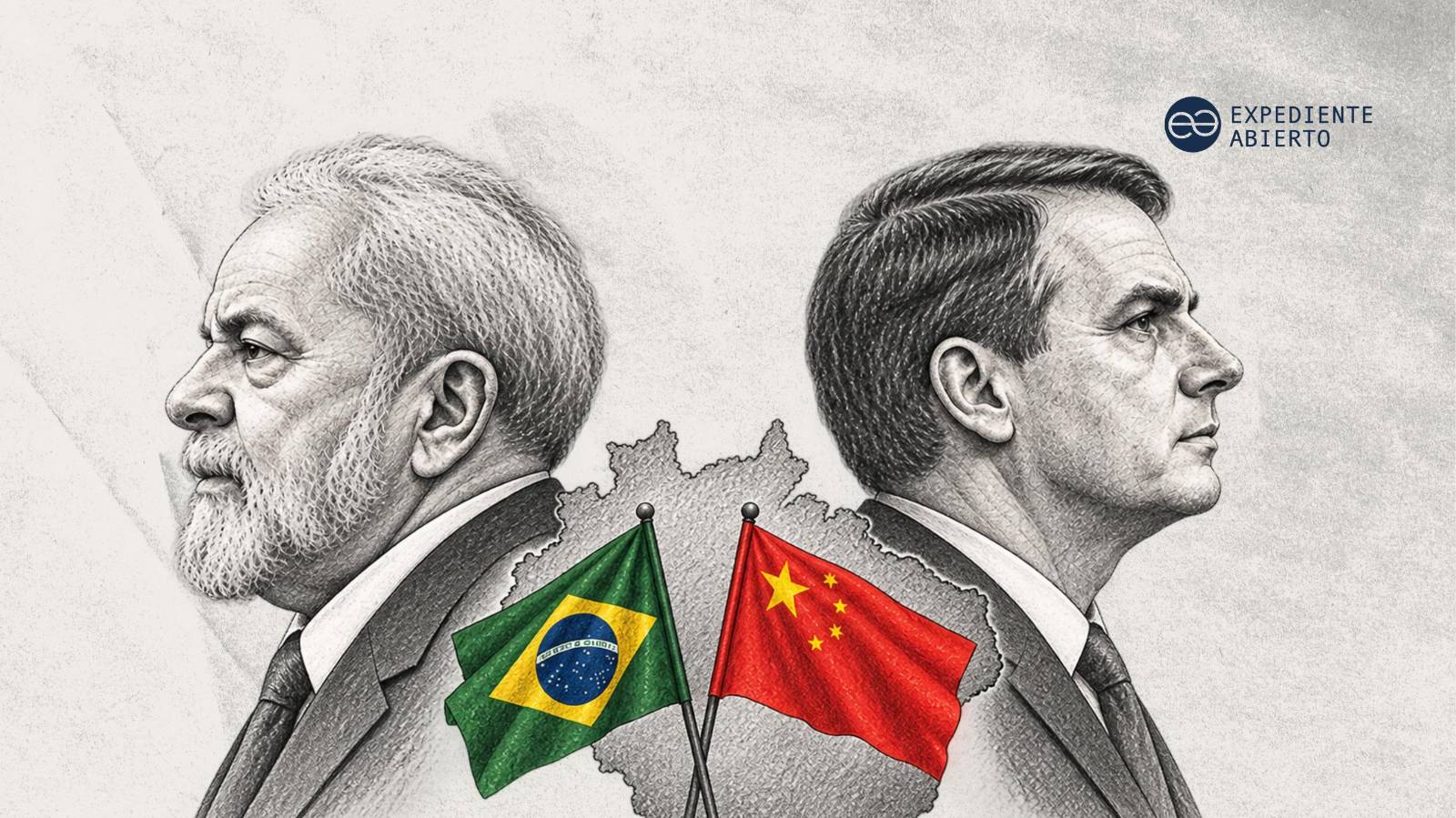
Brazil’s two-round presidential election in October 2026 will be an inflection point in defining the path of the country that accounts for half of the landmass, half of the population, and half of the economy of South America.
If 80-year-old leftist Luis Ignacio “Lula” da Silva is re-elected, he will enter what is likely to be his last presidential term, with a likely urgency to complete his agenda, freed of the need to woo moderates in his electorate as he responds to U.S. pressures and other considerations. If Flavio Bolsonaro wins in what polls anticipate will be decided in the second round and is currently a statistical tie, the regional implications will be equally profound. Brazil would likely shift from being the Trump Administration’s principal political foil in the region, to possibly joining the U.S.-led “America’s Shield” coalition.
Whoever wins, one of the most strategically impactful decisions of the next government will be how Brazil manages its deep and growing economic, political and military relationship with the People’s Republic of China (PRC).
Commerce
Brazil is by far the most significant PRC trade and investment partner in Latin America, giving the PRC substantial influence in the country, as well as enormous stakes in the continued stability of the relationship. Approximately 36% of China’s trade with, and 31% of its investment in South America is with Brazil. PRC-based companies invested $6.1 billion in the country in 2025 alone.
Key PRC commercial interests in Brazil include access to its foodstuffs, strategic minerals, ports and transportation infrastructure. China is also interested in Brazil as a market for advanced goods and services including manufacturing, electricity, telecommunications, AI and robotics, and space.
Brazil’s role as the China’s biggest Latin American supplier of soy, grains and other agricultural products has allowed it, under the leftist government of Luis Ignacio “Lula” da Silva, as a substitute for PRC purchases of such goods from the U.S. when trade tensions have flared between Washington and Beijing. The ability of the PRC to play the “Brazil card,” in turn, has not only benefitted China strategically, but has also created an enormous stake for Brazil’s agricultural sector in China. In 2025, an estimated 80% of Brazilian soy was purchased by the PRC.
In strategic minerals, the PRC-led CBMM coalition is the supplier of 80% of China’s niobium, among other rare earth elements. With the new U.S. Development Finance Corporation-led investment in the Sierra Verde project, and at least five other major Brazil rare earth projects in development, the country will be a key battleground between the US and PRC in strategic minerals. Correspondingly, Brazil’s next President will play a key role in whether Brazil is a net contributor to China’s global monopoly in rare earth sourcing and refining, or a part of the solution.
In transportation infrastructure, PRC-based entities already have stakes in seven Atlantic-coast port projects. Six Chinese construction companies are involved in concessions for the operation and expansion of Brazilian ports of Santos, Itajaí, and Rio Grande in the coming year.
Beyond ports, PRC-companies are interested in at least seven major Brazilian railway projects: Ferrogrão, the Ferrovia de Integração Oeste–Leste (FIOL), the Ferrovia de Integração Centro‑Oeste (FICO), the North–South Railway, the Malha Paulista, the Transnordestina, and the São Paulo Metro/CPTM project. The future of the contemplated “Bi-oceanic corridor” connecting the PRC-operated Pacific-coast port of Chancay, Peru will shape not only PRC access to the country’s agriculture, minerals and markets, but the relative commercial power of China’s COSCO, the operator of Chancay, versus competitors such as MERSK and Mediterranean Shipping (MSC) in transpacific maritime routes.
As illustrated by PRC interest in transportation projects, Brazil’s enormous market and tariff-free access to neighbors through MERCOSUR, have made it a hub for PRC-based manufacturers, particularly in strategic technology sectors, such as electric vehicles, where PRC-based companies such as BYD have captured more than 80% of sales. E Pursuing such markets, the China Brazil Business Council (CBBC) identified 52 active PRC-based investment initiatives in the country in 2025, up 33% over the prior year.
In the electricity sector, virtually all of the PRC’s major conglomerates, including StateGrid, China Three Gorges, and SPIC, have a significant stake in Brazil, collectively controlling over 12% of electricity transmission in the country. State Grid has invested $4.5 billion in high voltage, long distance power lines connecting the Belo Monte hydroelectric facility to Brazilian urban areas 2,500 kilometers to the south. With respect to electricity generation, in 2025, PRC-based companies invested $1.8 billion in solar, wind, and other sources.
In telecommunications and cloud computing, China’s Huawei, ZTE, Xiaomi, Oppo and others, are key players in the sector. Huawei’s digital infrastructure alone reaches 1.7 million Brazilians across 800 cities and towns. The Chinese company ZTE estimated that, in 2026, it controlled 30% of Brazil’s fixed broadband market.
In cloud computing, PRC-based companies have made Brazil the focus of their investment in Latin America. Alibaba entered the Brazil cloud computing and storage market in 2026 and currently operates two data centers there. Huawei’s cloud services is one of the biggest such operators in Brazil. It has three major cloud centers, São Paulo, Campinas, and Brasília, serving over 600 corporate and government clients. It estimates that its presence in Brazil has grown 15-fold since it entered the market in 2019.
As a compliment to cloud computing, Brazil is the Latin American country in which PRC-based firms have invested most significantly in AI and robotics, likely to be a key focus of Chinese competition for strategic technology markets in the future. Huawei is currently supplying components for an AI-enabled supercomputing center in Rio de Janeiro for the Brazilian government. In robotics, a Unitree G1 robot, purchased by Brazil’s military engineering school, was on display at the nation’s Independence Day parade, greeting President Lula. Beyond humanoid robotics, Chinese automation is in use in multiple Brazilian factories including the China Railway Road Corporation (CRRC) train production facility in Sao Paulo, the BYD Electric Vehicle and Battery plant in Bahia, COFCO and other Chinese agroindustrial companies crop monitoring and logistics oprations, the Renault car plant in Curitiba, and the Great Wall Motors factory in Sao Paulo, among others.
In space, the PRC has collaborated with Brazil’s space agency to develop and launch satellites since 1988 under the China-Brazil Earth Research Satellite (CBERS) program. China is scheduled to launch a Synthetic Aperture Radar (SAR) satellite for Brazil under the program in 2028, and to launch the program’s first satellite into Geosynchronous orbit in 2030. In addition, the PRC-based company Space Sail is currently collaborating with Brazil’s telecommunication agency Telebras, to launch a constellation of microsatellites from the strategic equatorial launch site, Alcantara. Space Sail may have 10,000 satellites by 2030 andwill compete with Elon Musk’s Starlink.
Political Cooperation
Brazil is strategically important to the PRC as its largest, most internationally facing partner in Latin America. The PRC has recognized Brazil as a “Global Strategic Partner” since 2012, one of the first states in the region to receive that designation. The two countries conduct regular senior-level coordination on bilateral affairs through the COSBAN inter-governmental coordination mechanism.
The role of both Brazil and China in the BRICS organization gives added weight to Brazil as a key country for PRC condition with leading countries of the developing world, including adversaries of the U.S. such as Russia and Iran. In September 2026, China’s President Xi Jinping, and Brazil’s Foreign Minister Mauro Viera, attended the BRICS summit in New Delhi, India.
BRICS has made Brazil strategically relevant to the PRC on a range of issues from questioning and actively resisting the Trump Administration’s policies, to pursuing alternatives to U.S. initiatives in the Persian Gulf and Ukraine, to collaborating in alternatives to the U.S. dollar and dollar-based clearing mechanisms in the international monetary system.
Beyond high-level international diplomacy, Brazil also cooperates with the PRC in a variety of “people-to-people” forums. Brazilian politicians and Party leaders regularly travel to the PRC, including six members of Sao Paulo’s city council in August 2025.
Within the educational domain, Brazil currently hosts 14 Confucius Institutes for Chinese language and culture education by the PRC government, the largest such program in the region.
Military Cooperation
Brazil, whose military is bigger than those of the rest of South America combined, has become the PRC’s most significant military partner in the region. That collaboration includes regular high level delegations, such as the 17 Chinese People’s Liberation Army (PLA) Generals who visited Brazil in 2023 at the beginning of Lula’s current administration. It also includes the participation of 33 PLA soldiers in Brazil’s Formosa exercise in 2024, as well as attendance by a high-level Brazilian delegation in the 6th China-Latin America Defense Forum, in September 2025. In January 2026, the Lula government hosted the Chinese military hospital ship Silk Road Arc in the port of Rio de Janeiro, including a joint maritime drill with Brazilian forces on January 15.
Highlighting the importance that it puts on military-to-military cooperation with the PRC, the Lula government named three General Officer-level attaches to its embassy in the PRC, a higher level of representation than any other state in Latin America.
Conclusion
Whoever wins Brazil’s October 2026 presidential election, the country is likely to continue its significant commercial and other relationships with the PRC, just as it did under Flavio Bolsonaro’s pro-U.S., anti-Communist father, Jair Bolsonaro. Nonetheless, Flavio Bolsonaro is likely to make very different choices than Lula, no longer politically constrained by elections, regarding how to manage the opportunities and risks of engagement with China, in the context of the concerns of Washington.
A follow-on Lula government could deepen Brazil’s reliance on the PRC as a market and investor, and use that expanded relationship as a base to more profoundly challenge the Trump Administration agenda in the region and globally. Such a Lula government could make Brazil a key supplier of strategic minerals to the PRC, and an alternative to the U.S. for Chinese agricultural needs. It could also use Brazilian territory to give the PRC even greater military and space access to the hemisphere, as well as making Brazil China’s principal platform for its efforts to dominate global markets in key strategic technologies, including cloud computing, artificial intelligence and robotics.
A Flavio Bolsonaro administration, by contrast, would be more likely to respond to U.S. concerns about the PRC in ways that undercut the latter’s access to the region’s strategic minerals, or to military and space cooperation. A Flavio Bolsonaro government would arguably also be more likely to restrict PRC options for turning to Brazil for agricultural goods if it again decreases purchases of such goods from the U.S. In international forums, such a government would likely give the PRC fewer options to weaponize the BRICS in political and financial terms against the US. It also be more disposed than Lula to constrain Brazilian purchases of Chinese AI and robotics or cooperate with the PRC in those domains in ways that would prejudice Western companies in the global competition.
In short, what happens in Brazil’s election in October will matter profoundly not only for the direction of the country, but also for Washington, China, and the region.